
From NCLT insolvency petitions to DRT recovery suits — a practitioner’s guide to commercial dispute resolution in India’s busiest courtrooms.
The Commercial Litigation Landscape in India
Commercial litigation in India operates at the intersection of accelerated business expectations and procedural complexity. The expansion of economic activity post-liberalisation has led to a significant rise in contract disputes, debt recovery actions, insolvency proceedings and high-stakes corporate litigation.To address this growing burden, specialised forums such as Commercial Courts, Debt Recovery Tribunals (DRTs) and the National Company Law Tribunal (NCLT) have been established. While these forums have streamlined certain aspects of dispute resolution, each functions within its own procedural framework, requiring litigants to navigate parallel and often overlapping legal regimes.
Section 138 of the Negotiable Instruments Act: Volume-Driven Litigation
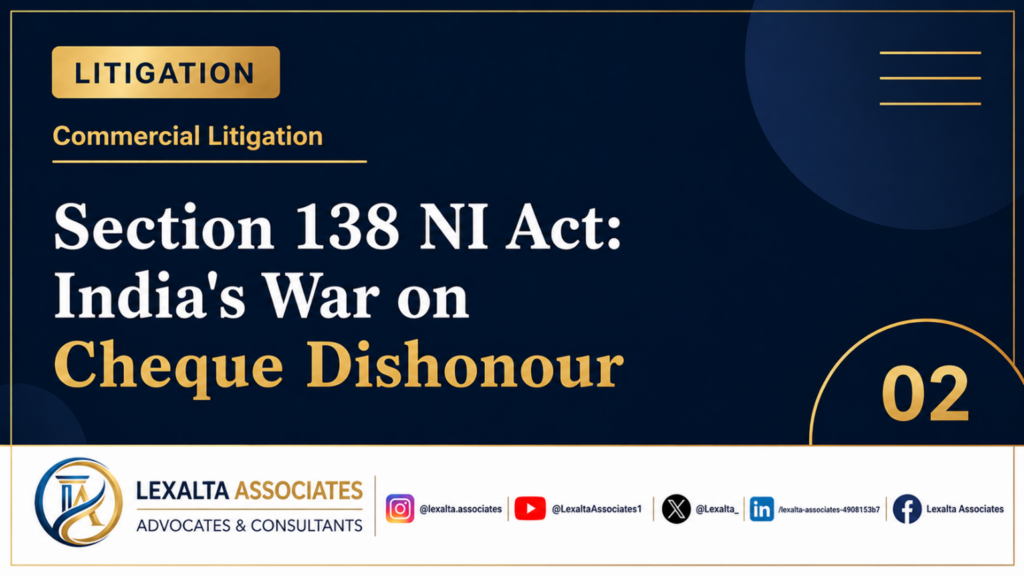
Section 138 of the Negotiable Instruments Act, introduced in 1988, continues to generate one of the highest volumes of litigation in India, with an estimated over 35 lakh pending cases as of 2024. The provision criminalises the dishonour of cheques due to insufficiency of funds, prescribing penalties including imprisonment of up to two years and fines extending to twice the cheque amount. The Supreme Court of India in Dashrath Rupsingh Rathod v. State of Maharashtra streamlined jurisdictional ambiguities by holding that cases must be filed where the payee’s bank is located, thereby curbing forum shopping. Subsequent statutory amendments introducing Sections 143A and 148 have further reshaped the litigation landscape by enabling interim compensation and mandatory deposits at the appellate stage, effectively incentivising early settlement.
Debt Recovery Tribunals: A Specialised Mechanism for Financial Institutions
The Recovery of Debts and Bankruptcy Act, 1993 (RDDBFI Act) established DRTs and appellate tribunals (DRATs) as specialised forums for recovery of debts exceeding Rs. 20 lakhs due to banks and financial institutions. Proceedings before the DRT typically involve the filing of an Original Application (OA), issuance of notice, submission of defence and adjudication. However, in practice, DRT proceedings frequently run parallel to enforcement actions under the SARFAESI Act, requiring careful coordination between litigation and enforcement strategies. In Mardia Chemicals Ltd. v. Union of India, the Supreme Court of India upheld the constitutional validity of the SARFAESI Act, while recognising the borrower’s right to approach the DRT within 45 days of possession being taken, thereby balancing creditor enforcement powers with procedural safeguards.
NCLT: The Unified Forum for Corporate Disputes
The National Company Law Tribunal (NCLT), established in 2016, consolidated the jurisdiction of multiple legacy bodies, including the Company Law Board and BIFR, into a single adjudicatory forum. Today, it functions as the principal forum for company law disputes, insolvency proceedings under the Insolvency and Bankruptcy Code (IBC) and corporate restructuring matters.The NCLT’s docket remains substantial, encompassing insolvency petitions, oppression and mismanagement claims and legacy winding-up matters transferred from High Courts. Persistent delays have drawn scrutiny from the Supreme Court of India, which in 2023 emphasised the need for institutional and roster management reforms to improve efficiency.
Commercial Courts: Structural Reform in Action
The enactment of the Commercial Courts Act, 2015 marked a significant step toward modernising commercial dispute resolution in India. The legislation introduced:
- Mandatory pre-institution mediation (Section 12A)
- Strict case management timelines
- Costs for frivolous or dilatory conduct
Appeals from Commercial Courts and Commercial Divisions are now heard by the Commercial Appellate Divisions of High Courts, creating a more coherent and specialised appellate framework. Empirical data, particularly from the Delhi High Court Commercial Division, indicates a marked improvement in disposal timelines from over four years to approximately 18 months in efficiently managed cases reflecting the Act’s structural impact.
White-Collar Litigation: Expanding Multi-Forum Exposure
White-collar and economic offence litigation has evolved into a multi-forum phenomenon, often involving simultaneous proceedings before criminal courts, regulatory authorities and civil forums. Matters relating to bank fraud, securities violations and benami transactions frequently engage agencies such as SEBI and enforcement bodies under the Prevention of Money Laundering Act (PMLA). The PMLA regime, particularly its attachment provisions, has emerged as a powerful investigative tool. This has necessitated a parallel defence strategy involving challenges before the Adjudicating Authority and the PMLA Appellate Tribunal, in addition to criminal proceedings.
Navigating Complexity Through Strategy
The commercial litigation landscape in India is defined not merely by specialised forums, but by the strategic interplay between them. While institutional reforms have improved procedural efficiency in certain areas, fragmentation across forums continues to demand highly coordinated legal strategy. Effective commercial litigation today requires more than substantive legal knowledge. It demands procedural agility, forum awareness and the ability to anticipate cross-forum implications, all of which are critical to achieving timely and commercially viable outcomes.