
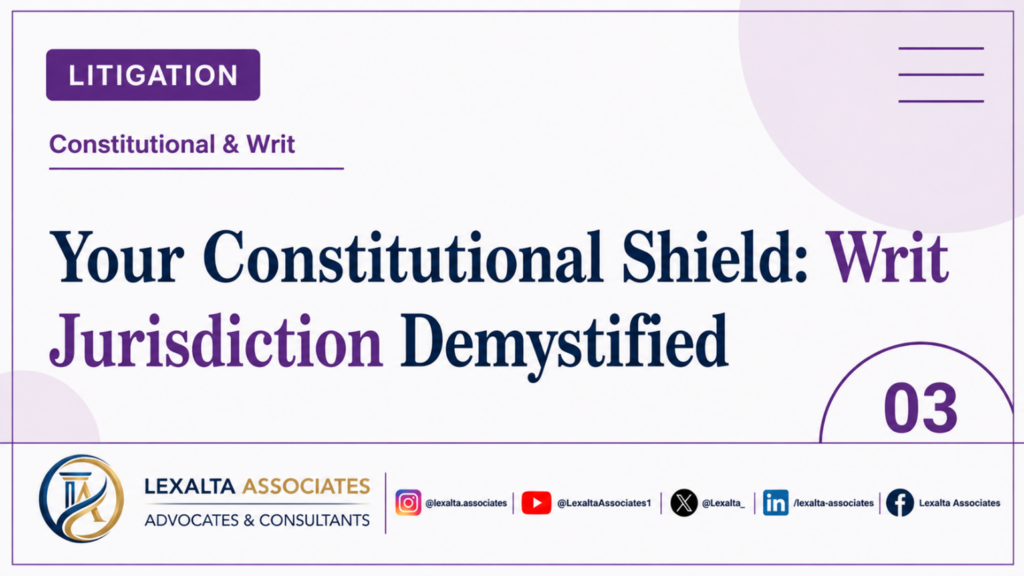
How High Courts and the Supreme Court protect fundamental rights — PIL evolution, SLP strategy, and the art of constitutional advocacy.
The Constitutional Architecture of Judicial Review in India
India’s constitutional framework vests the Supreme Court of India and High Courts with expansive powers of judicial review through the issuance of writs inlcuding Habeas Corpus, Mandamus, Prohibition, Certiorari and Quo Warranto, under Articles 32 and 226 respectively. These writs are not mere procedural devices but substantive constitutional guarantees, forming the bedrock of rights enforcement. As early as Romesh Thappar v. State of Madras, the Court recognised that the right to approach the Supreme Court under Article 32 is itself a fundamental right, reinforcing the centrality of judicial remedies in India’s constitutional design.
Habeas Corpus: The Protection of Personal Liberty
The writ of Habeas Corpus, literally meaning “produce the body”, remains the most powerful safeguard against unlawful detention. Its constitutional significance was tested during the Emergency in ADM Jabalpur v. Shivkant Shukla, where the Court controversially held that the right to seek Habeas Corpus could be suspended. This position now stands firmly repudiated. In K.S. Puttaswamy v. Union of India, the Court reaffirmed that the right to life and personal liberty under Article 21 is grounded in inalienable constitutional values, effectively restoring Habeas Corpus as a non-derogable safeguard. Today, courts routinely entertain Habeas petitions even in the presence of alternate remedies, underscoring a strong judicial commitment to protecting personal liberty.
Mandamus: Enforcing Public Duties
The writ of Mandamus serves as a crucial instrument to compel public authorities to discharge statutory or public duties. Where a legal obligation exists and is not fulfilled, courts may intervene to ensure compliance. Its application spans regulatory enforcement, administrative accountability and policing duties. In Lalita Kumari v. Government of Uttar Pradesh, the Supreme Court used this principle to mandate the registration of FIRs in cognizable offences, reinforcing the duty of law enforcement agencies.
The essential prerequisites remain:
- A clear legal right in the petitioner
- A corresponding public duty on the authority
Public Interest Litigation: Expanding Access to Justice
Public Interest Litigation (PIL) represents a uniquely Indian evolution of constitutional jurisprudence. In S.P. Gupta v. Union of India, the Supreme Court liberalised the doctrine of locus standi, enabling public-spirited individuals to seek relief on behalf of disadvantaged groups.
This innovation has enabled transformative interventions, including:
- The Vishaka guidelines on workplace sexual harassment
- Environmental protection measures
- Expansion of socio-economic rights
However, the Court has increasingly cautioned against misuse. In State of Uttaranchal v. Balwant Singh Chaufal, it laid down safeguards to prevent frivolous or publicity-driven litigation, signalling a shift toward responsible PIL jurisprudence.
Special Leave Petitions: The Supreme Court’s Discretionary Gateway
Article 136 empowers the Supreme Court to grant Special Leave to Appeal (SLP) against judgments of any court or tribunal. This is not an appeal as of right but a discretionary jurisdiction, exercised to address substantial questions of law or grave injustice. In Pritam Singh v. State, the Court clarified that it would ordinarily refrain from interfering with concurrent findings of fact, unless such findings are shown to be perverse. In practice, the success of an SLP often turns on how the question of law is framed, particularly where constitutional or systemic issues are involved.
Fundamental Rights Enforcement: Emerging Digital Frontiers
The recognition of the right to privacy as a fundamental right in K.S. Puttaswamy v. Union of India has significantly expanded the scope of constitutional litigation. Contemporary challenges now extend to:
- Aadhaar-linked regulatory frameworks
- State surveillance and data protection
- Internet shutdowns and digital access
In Anuradha Bhasin v. Union of India, the Court introduced the doctrine of proportionality into the adjudication of internet restrictions, requiring that state action be necessary, proportionate and subject to procedural safeguards. This marks a transition toward rights-based scrutiny in the digital age, where constitutional protections must adapt to technological realities.
Judicial Review as a Living Constitutional Force
Judicial review in India is not static but it is a dynamic, evolving instrument of constitutional governance. From safeguarding personal liberty to regulating state power in emerging technological domains, writ jurisdiction remains central to the enforcement of fundamental rights. As the nature of disputes evolves, the role of constitutional courts continues to expand, requiring a careful balance between institutional restraint and rights-based intervention. Ultimately, the strength of India’s constitutional architecture lies in its ability to ensure that power remains accountable and rights remain enforceable.